Some of the most interesting commodities in international trade today were, until recently, waste streams. Wood pellets, sugarcane bagasse, and açaí seed all share a common story: material once burned in open fields or left to rot is now densified, certified, and shipped as fuel.
The Three Feedstocks
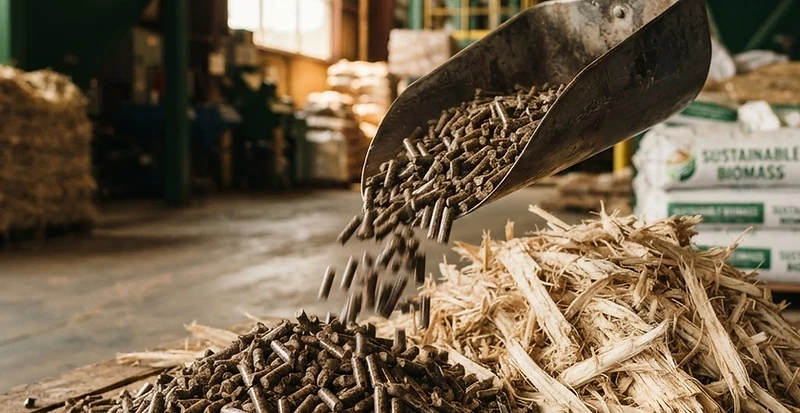
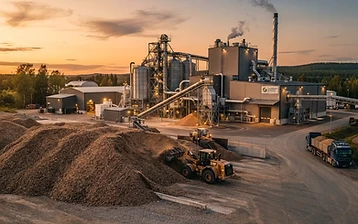
Wood pellets are the established benchmark. Sawdust, mill residues, and forestry thinnings are dried and compressed into uniform pellets with roughly the energy density of low-grade coal and a fraction of its ash. Europe's district heating and power sector, plus Japan and South Korea's co-firing plants, drive a global market measured in tens of millions of tonnes a year.
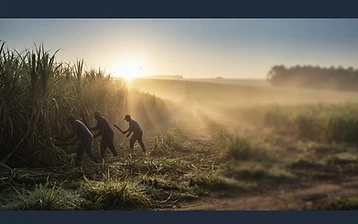
Sugarcane bagasse — the fibrous residue after juice extraction — has powered sugar mills' own boilers for a century. What is new is surplus bagasse leaving the mill gate as densified fuel for third parties, turning an energy cost center into a revenue line for millers in Brazil, India, and Southeast Asia.
Açaí seed, a newer entrant from the Amazon region, shows the model's range: processing pulp leaves roughly 80–85% of the berry as seed. Densified, it becomes a solid biomass fuel with a competitive calorific value, creating an income stream for processing communities from what was pure waste.
The Common Thread: Circularity
Each feedstock passes the same test: no land diverted from food, no forest cleared for fuel — only residues seeking a higher-value use. That is the circular economy in commodity form.
Why Demand for Verified Biomass Is Growing
Biomass buyers — particularly regulated power producers in Europe and Northeast Asia — cannot simply purchase fuel. Sustainability legislation requires proof of the fuel's origin and carbon accounting. That has produced a certification layer the market now treats as mandatory:
- ENplus / FSC / PEFC for sustainable forestry chains of custody
- SBP (Sustainable Biomass Program) for woody biomass destined for energy
- ISCC and similar schemes covering agricultural residues and land-use criteria
- Pellet quality standards (EN ISO 17225) governing durability, moisture, ash, and chlorine
A cargo without the right certificates is not a discounted product; at many power plants, it is an unusable one.
What Buyers Evaluate
Beyond certification, industrial buyers weigh:
- Calorific value and moisture — the two numbers that determine delivered energy
- Ash content and chemistry — chlorine and alkali metals drive boiler corrosion
- Durability — pellets that arrive as fines lose handling and combustion value
- Logistics fit — biomass is bulky relative to its value, so containerized vs. vessel-parcel economics decide viable lanes
A Market With Room to Grow
The binding constraint on biomass trade is less feedstock supply than verification capacity — certified supply chains take years to build, while demand grows with every coal plant converted to co-firing. Suppliers who can document a residue stream from origin to hold carry a durable premium.
The energy transition will be measured in tonnes of verified residue, not in press releases.
For producers, biomass turns disposal cost into export revenue. For buyers, it is a fuel line that decarbonizes without redesigning a boiler. That alignment is why this market keeps compounding.