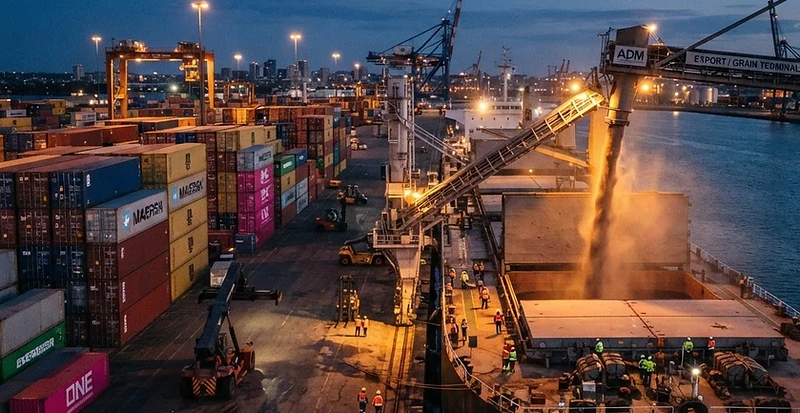
One of the earliest decisions an importer makes is not what to buy, but how to move it. For most commodity categories the choice comes down to containerized freight or bulk shipping — and getting it right depends on order size, product characteristics, and how much logistics infrastructure you want to own.
Containerized Shipping: 20' and 40' FCL
A standard 20-foot container (TEU) carries roughly 21–25 metric tonnes of bagged product such as pulses, sugar, or rice. A 40-foot container roughly doubles the volume but not always the payload weight, making it better suited to lighter cargo.
The advantages for mid-sized buyers are structural:
- Low entry barrier. A first order of one container is routine. Bulk carriers start making sense at thousands of tonnes.
- Cargo security and segregation. Sealed steel boxes reduce pilferage and let you mix products — one container of beans, the next of gluten-free rice — under one booking.
- Simplified handling. Containers move door-to-door without repackaging: from the supplier's stuffing point to your warehouse floor.
- Widely available. virtually every port and inland hub is container-equipped, extending your choice of origins.
The trade-offs: per-tonne freight is higher than bulk, and some products — clumping flour, for instance — need liner bags or climate protection inside the box.
Bulk and Breakbulk
Bulk vessels move loose cargo (grain, sugar, fertilizer) in holds; breakbulk moves bagged or unitized cargo on pallets or in sling loads. The economics are compelling at scale — per-tonne freight drops sharply, and chartering gives sophisticated buyers control over timing and routing.
But bulk demands more of the buyer:
- Volume commitment. Vessel economics require parcels measured in thousands of tonnes.
- Port infrastructure. You need a discharge port with silos, grabs, and conveyor capacity — or you pay for it.
- Operational sophistication. Charter parties, demurrage terms, draft surveys, and hold inspections are specialist work.
- Financing weight. Larger single shipments concentrate more working capital in one vessel and one sailing.
Breakbulk sits between the two: it suits bagged cargo volumes too large for reasonable container counts but too small or destination-constrained for a bulk vessel.
A Practical Rule of Thumb
| Order profile | Fit |
|---|---|
| Under ~500 tonnes, mixed SKUs, first orders | Containers |
| ~1,000–3,000 tonnes, single product, silo-capable port | Breakbulk |
| 5,000+ tonnes, homogeneous bulk product | Bulk vessel |
Many growing buyers graduate deliberately: containers to prove a supplier and a market, then consolidation into breakbulk or bulk as volumes justify it.
What Containerization Changed
Before containerization, only companies able to charter tonnage could import directly. Containers made international sourcing a mid-market activity — and for emerging-market suppliers, they opened direct access to buyers worldwide without either side needing port infrastructure of its own.
The right mode is not the cheapest per tonne. It is the one whose volume, risk, and complexity match what your operation can actually absorb.
Start where your volume is, and let the mode grow with the order book.