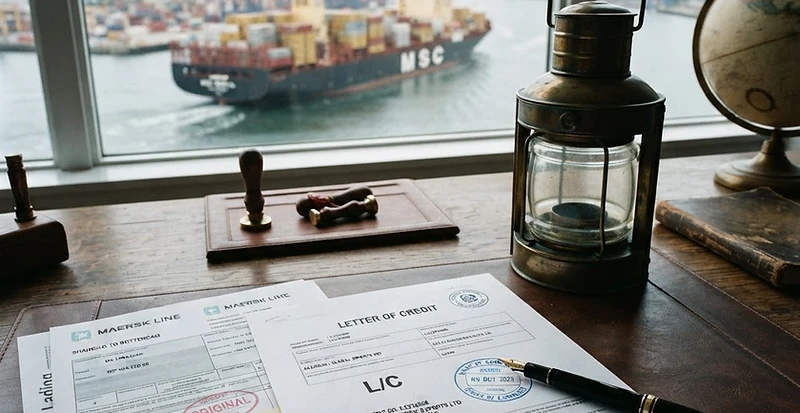
For a mid-sized buyer placing a first order with an overseas supplier, the single largest question is rarely price. It is: what happens if the other side does not perform? Letters of credit exist to answer exactly that question.
The Risk Being Managed
Cross-border commodity trade pairs two parties who often have never met, operating under different legal systems, thousands of miles apart. The seller does not want to ship goods before being paid. The buyer does not want to pay before the goods are shipped — and ideally, before an independent party confirms they match the contract. Left unresolved, this standoff kills transactions.
Payment instruments resolve it by placing a bank between the two sides.
How a Letter of Credit Works
A letter of credit (LC) is a bank's conditional promise to pay. The buyer's bank issues it in favor of the seller, committing to pay a stated amount once the seller presents documents proving the goods were shipped as agreed — typically the bill of lading, commercial invoice, packing list, and origin and quality certificates.
Two features matter most:
- Payment is documentary, not subjective. The bank pays against correctly presented documents, not against opinions about quality. This is why the quality certificate named in the LC must be issued by the inspection firm both parties agreed to in the contract.
- Confirmation adds a second bank. When the issuing bank sits in an emerging market, a confirming bank in the seller's country adds its own payment undertaking — effectively importing the credit risk into a jurisdiction the seller trusts.
The Variants Buyers Encounter
A standby letter of credit (SBLC) works in reverse emphasis: it sits dormant and is drawn only if the buyer fails to pay by the due date. Sellers treat it as a safety net under open-account terms, and it suits repeat relationships better than first shipments.
A documentary credit (DLC) is the instrument most people mean when they simply say "LC" — the classic documents-against-payment structure described above.
For recurring flows, revolving LCs renew automatically up to a value ceiling, reducing the paperwork burden of repeat orders.
Why This Matters for Mid-Sized Buyers
Large corporates manage counterparty risk with credit insurance and treasury teams. Mid-sized importers usually cannot. For them, an LC converts an unfamiliar foreign counterparty into a familiar instrument: a bank obligation governed by internationally recognized rules (UCP 600, published by the International Chamber of Commerce).
The practical payoff is access. Suppliers who would decline an unknown mid-sized buyer on open terms will ship readily against a confirmed LC — and sometimes at better prices, because their own financing costs drop when payment risk disappears.
The Fine Print
Most payment disputes trace back to documentation, not goods:
- Draft the contract, LC, and inspection clause as one coherent package.
- Name the exact inspection firm and the certificate it must issue.
- Allow realistic presentation deadlines — quality inspections and vessel delays take time.
- Never let the LC expiry precede the latest possible shipment plus transit for documents.
Financing is not an afterthought to the trade — it is part of the price.
Structure it deliberately, and the instrument protects both sides of the table.