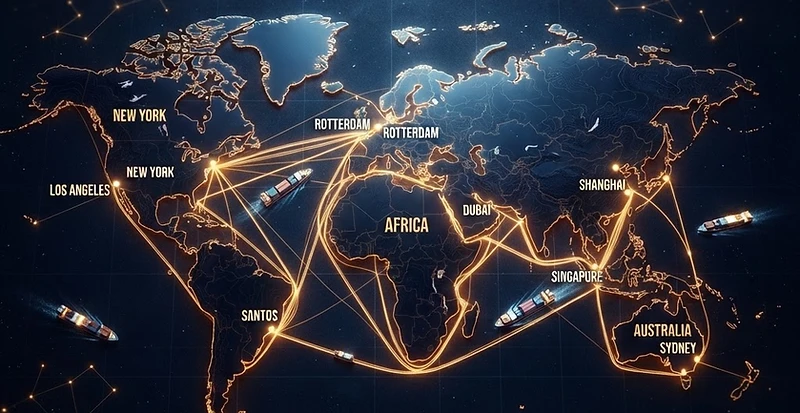
The last several years have delivered a series of object lessons in supply chain concentration. A canal blocked for six days. A war that removed a major grain exporter from the market. A drought that cut a South American soy harvest. Each event stranded buyers who had built their sourcing on a single origin — and rewarded those who had not.
The Case in One Paragraph
Multi-origin sourcing is insurance that pays for itself in optionality. When one region's crop fails, a port strikes, or a tariff regime shifts, a buyer with qualified suppliers in three regions absorbs the shock by redirecting volume. A buyer with one origin absorbs it as lost production, missed deliveries, or panic buying at spot peaks.
The Risks Being Hedged
- Weather and crop failure. Droughts, floods, and El Niño/La Niña cycles are origin-specific. They are also the least predictable risk in the system.
- Price shocks. A regional shortage moves global benchmarks, but it moves local prices hardest. Diversified buyers can shift weight toward the cheaper origin.
- Geopolitics and policy. Export bans, tariffs, sanctions, and currency controls arrive with little warning and vary by origin.
- Logistics chokepoints. Canals, straits, and congested ports are single points of failure; multiple origins rarely route through all of the same ones.
What Diversification Actually Requires
Origin diversification is not a spreadsheet exercise — each additional origin must be qualified before it is usable:
- Supplier verification. Facility audits, certifications, references, and trial shipments take months, not days.
- Specification alignment. The same nominal product differs by origin — Brazilian versus Indian soy, Thai versus Vietnamese rice. Processing lines must tolerate the differences.
- Logistics set-up. Incoterms, ports, container availability, and transit times differ by lane.
- Financing readiness. LC issuing banks treat new origins differently; documents and risk pricing must be pre-arranged.
This is where a trading house earns its keep: maintaining pre-qualified suppliers across regions so buyers can redirect volume without repeating the qualification cycle themselves.
The Cost Side
Diversification is not free. Splitting volume across origins can sacrifice volume discounts, complicate quality management, and add overhead. The workable compromise for many mid-sized buyers is a primary-plus-backup structure: a main origin carrying most volume, one qualified alternate kept warm with occasional orders, and a third under evaluation. Costs are modest; the option is real.
Reading the Trend
Institutional buyers increasingly treat origin concentration as a governance issue, with procurement teams reporting single-origin exposure to boards the way they report currency exposure. Suppliers, for their part, now market multi-origin capability as a headline feature rather than a footnote.
Resilience is not having a backup plan written down. It is having a backup supplier already qualified.
Regional shocks are certain; their timing is not. The buyers who weather the next one will be those who diversified while it was quiet.